FacePlex: Full-Duplex Joint Speech-Facial Motion Generation for Conversational Avatars

* Equal contribution
1 Korea University Logo 2 Klleon Logo
Full-Duplex Streaming Joint Speech & Motion Rolling Flow Matching
FacePlex Scenario

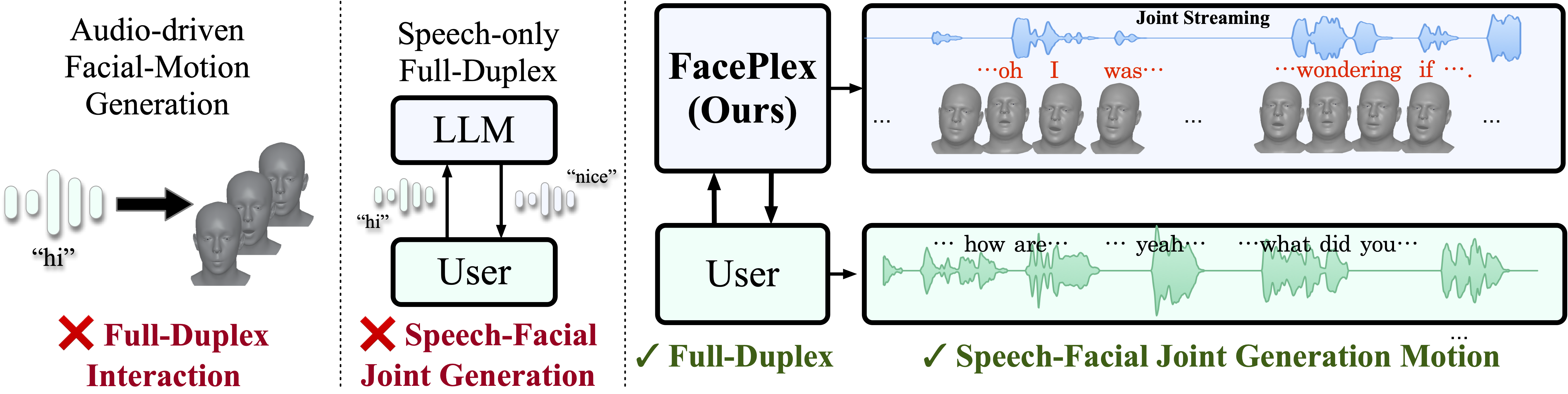
FacePlex jointly generates speech audio and facial motion token-by-token in a single streaming pass, enabling face-to-face conversational avatars that listen, think, and speak simultaneously.

Abstract

Natural face-to-face conversation requires real-time speech generation together with synchronized facial motion. Existing systems only partially address this problem: speech-only full-duplex models can generate speech in real time but do not produce facial motion, while audio-driven facial motion models animate a face from already available audio rather than jointly generating speech and motion online.

To bridge this gap, we first formalize full-duplex joint speech-facial motion generation, where speech tokens and facial motion tokens are produced together every step. Building on this formulation, we propose FacePlex, a unified streaming framework with two key components. First, Rolling Flow Matching adapts flow matching to online motion generation by committing new motion frames at each streaming step. Second, Rolling Cross-Attention couples the streaming audio queue with the motion queue, allowing speech and facial motion to condition each other as generation progresses.

Through extensive experiments, ablation studies, and a user study, we show that FacePlex enables full-duplex joint speech-facial motion generation under online streaming constraints, while achieving stronger lip-sync quality and motion fidelity than audio-driven facial motion baselines.

Method Overview

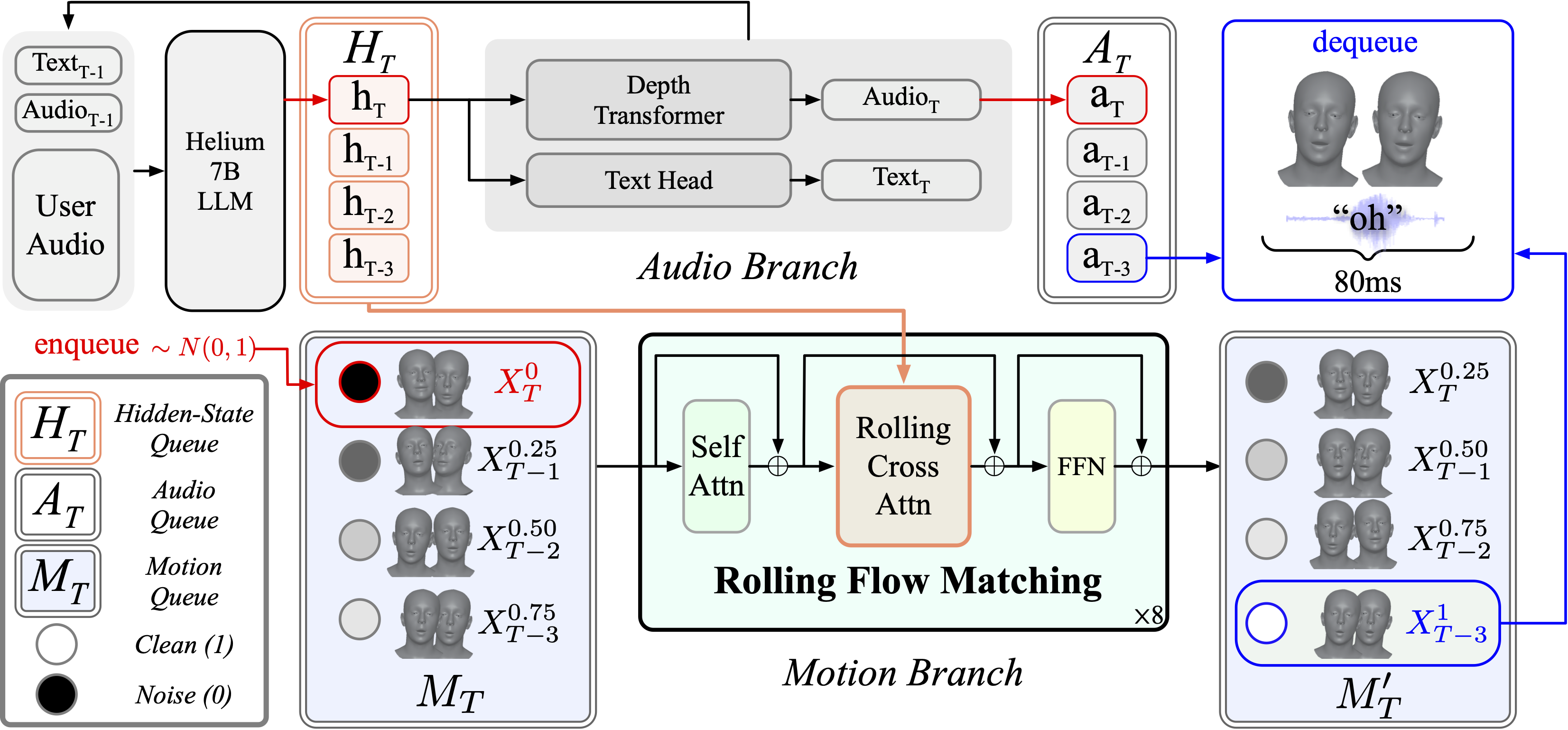
FacePlex is a single streaming model that produces speech tokens and facial motion tokens jointly at every step. Two design choices make this possible:

FacePlex streaming pipeline

Overview of FacePlex. At each training step, the LLM backbone, audio branch, and motion branch are jointly trained, taking the user audio and previous model streams as input to produce a hidden state and the next audio chunk. The audio chunk is temporarily enqueued so the motion branch can update a rolling motion queue with a short predicted-speech look-ahead. With L = 4 queue slots, the front audio chunk and its aligned facial-motion pair are emitted together, producing synchronized full-duplex avatar output.

FacePlex main method

Rolling Flow Matching (RFM)

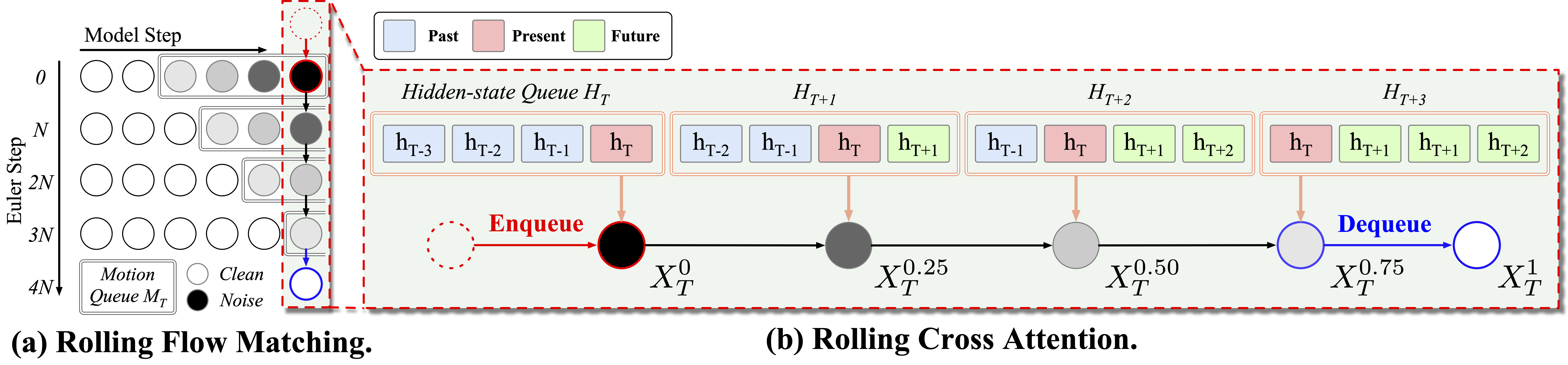
Standard flow matching denoises an entire fixed-length sequence in one shot, which is incompatible with online streaming. Rolling Flow Matching recasts the process as a sliding window: at every step a new motion frame is committed at the head of the queue while the tail is still being refined. This yields a motion stream that is emitted token-by-token alongside the speech stream, with the same low-latency cadence as the audio backbone.

Rolling Cross-Attention (RCA)

Speech and facial motion must condition each other — lips depend on phonemes, and head/jaw motion shapes spectral content. Rolling Cross-Attention couples the streaming audio queue with the motion queue so that, at each step, the two modalities exchange information over a bounded local window. The model therefore stays causal and online while generating tightly synchronized speech and motion.

Quantitative Comparisons

Main comparison against representative full-duplex speech models (Moshi, Freeze-Omni, PersonaPlex) and audio-driven facial motion models (ARTalk, DualTalk, UniLS). FacePlex is the only method that produces full-duplex speech and facial motion jointly within a single streaming forward pass.

Method Capability Full-Duplex Speech Facial Motion
FDS M Pause TOR ↓ BC Freq. ↑ Turn Lat. ↓ Intr. Lat. ↓ PLRS ↑ S-LVE ↓ S-MHD ↓ S-FDD ↓ L-FDD ↓ L-PFID ↓
Moshi 0.990 0.001 0.283 0.258 N/A
Freeze-Omni 0.700 0.002 0.955 1.364
PersonaPlex 0.587 0.025 0.078 0.427
ARTalk N/A 0.186 10.318 2.325 27.254 27.368 0.109
DualTalk 0.208 15.364 3.406 27.272 28.481 0.110
UniLS 0.166 16.138 3.761 34.432 36.250 0.044
FacePlex Ours 0.584 0.028 0.078 0.399 0.239 7.896 1.784 24.629 24.567 0.031

Main comparison. Bold marks the best result, underline the second-best. FDS: full-duplex speech support; M: facial motion generation. Speech-side metrics cover pause handling (Pause TOR), backchanneling (BC Freq., where BC = backchannel), turn-taking latency (Turn Lat.), and interruption latency (Intr. Lat.). PLRS measures audio–motion synchronization; S/L denote speaking and listening intervals. LVE, MHD, FDD, and P-FID are Lip Vertex Error, Mean Head Distance, Upper-Face Dynamics Deviation, and Pose Fréchet Inception Distance, respectively. N/A indicates an unsupported capability or inapplicable metric.

User Study

We further conducted a human evaluation with 25 participants. Each participant watched 5 conversation sessions; for every session, four videos generated from the same input by ARTalk, DualTalk, UniLS, and FacePlex were shown with model identities hidden and order counterbalanced. Participants rated each video on a 1–5 MOS scale across four axes: Lip Synchronization (Lip Sync), Facial Expression & Speech Natural Coherence (Natural & Coherence), Conversational Interaction (Interaction), and Overall Quality (MOS). FacePlex receives the highest mean rating on every axis.

Method Lip Sync ↑ Natural & Coherence ↑ Interaction ↑ MOS ↑
ARTalk 2.080 1.864 2.832 2.240
DualTalk 3.000 2.888 3.360 3.080
UniLS 2.776 2.816 3.344 2.992
FacePlex Ours 3.592 3.624 3.920 3.736

User study results. Mean rater score on a 1–5 scale (higher is better) across four perceptual axes. Bold = best; FacePlex wins every axis, with the largest absolute gain on Naturalness & Coherence and Lip Sync.

Word-Level Lip-Sync Comparisons

For each keyword we render the same moment from all five methods side-by-side. FacePlex tracks viseme transitions tightly without lagging or smearing. (Click any video to enable audio.)

GT — Ground Truth Audio-Driven Baselines FacePlex (Ours)

Pairwise Comparisons vs. Baselines

Ten utterances per baseline, rendered as side-by-side videos (baseline on the left, FacePlex on the right). Audio is identical across both panels — only the generated facial motion differs.

vs. ARTalk

vs. DualTalk

vs. UniLS

Full-Duplex Conversational Session

End-to-end conversational sessions in which two avatars communicate. Both speakers' speech and facial motion are generated jointly and online — no audio is provided to the model in advance while others provided pre-given full-utterance audios. Each strip below shows all four methods rendered for the same speaker turn so reviewers can compare lip-sync, prosody-driven expression, and listener behavior on identical content.

GT ARTalk · DualTalk · UniLS FacePlex (Ours)
A Speaker A
GT ARTalk DualTalk UniLS FacePlex (Ours)
B Speaker B
GT ARTalk DualTalk UniLS FacePlex (Ours)

Full-session videos play the entire turn for each speaker (~10 seconds). Click a video to unmute and verify joint speech-motion synchrony.

Gaussian Avatar Integration

Because FacePlex emits speech and facial motion online, its outputs can naturally drive any downstream avatar renderer. Here we plug FacePlex into a conventional, off-the-shelf Gaussian Splatting head avatar — the renderer is used exactly as released by its authors, with no fine-tuning, no architectural change, and no FacePlex-specific adaptation. All clips below are FacePlex outputs rendered with that pretrained GS avatar, demonstrating that our streaming pipeline plugs directly into existing photorealistic head avatars.

FacePlex motion + audio → off-the-shelf GS head avatar photorealistic output
Note The Gaussian Splatting head avatar is a pretrained, third-party renderer used as-is. Any visual artifacts (texture flicker, view-dependent ghosting, hair or boundary glitches, etc.) observed in the clips below are inherited from that conventional GS avatar modelnot from FacePlex. FacePlex contributes only the streaming speech and facial-motion signal that drives the renderer; the rendering quality reflects the off-the-shelf avatar, not our method.

Showcase Reels

Each reel stacks five distinct conversational clips side-by-side, all rendered with the Gaussian head avatar from FacePlex's streaming output (twenty examples in total).

Paired Avatar Conversation

A complete two-speaker dialogue rendered with the Gaussian head avatar. Both speakers' speech and facial motion are jointly generated by FacePlex in a single streaming forward pass.

Speaker A Speaker B

Reminder: rendering artifacts above belong to the off-the-shelf GS avatar renderer, not to FacePlex. FacePlex itself is unchanged across all results.

BibTeX

@article{lim2026faceplex,
  title   = {FacePlex: Full-Duplex Joint Speech-Facial Motion Generation for Conversational Avatars},
  author  = {Lim, Habin and Lee, Jae-Ho and Lew, Hah Min and Kang, Ji-Su and Park, Gyeong-Moon},
  journal = {arXiv e-prints},
  pages   = {arXiv--2606},
  year    = {2026}
}